
4MOST Milestone: 4MOST Captures First Light
by Harry Addison on 2025-10-21



On October 18 2025, the 4-metre Multi-Object Spectroscopic Telescope (4MOST) facility, installed on the VISTA telescope at the European Southern Observatory’s (ESO) Paranal Observatory in Chile, obtained its first light. This milestone is a crucial step in the life of any telescope marking the moment it is ready to begin its scientific journey. Moreover, 4MOST does not simply take images of the sky; it records spectra, capturing the light of each object in every individual colour. With this capability, it can unravell the light of 2,400 celestial objects simultaneously into 18,000 colour components, allowing astronomers to study their detailed chemical composition and properties.
Once fully operational, 4MOST will investigate the formation and evolution processes of stars and planets, the Milky Way and other galaxies, black holes and other exotic objects, and of the Universe as a whole. By analysing the detailed rainbow-like colours of thousands of objects every 10–20 minutes, 4MOST will build a catalogue of temperatures, chemical compositions, velocities and many more physical parameters of tens of millions of objects spread across the entire Southern sky.
Development started in 2010 and is the largest multi-object spectroscopic survey facility in the southern hemisphere. It is unique in its combination of large field of view, number of simultaneous observed objects, and number of spectral colours simultaneously registered. The facility has been designed to operate for at least the next 15 years.
The Leibniz-Institut für Astrophysik Potsdam (AIP) is the lead institute of the 4MOST Consortium that has built and will scientifically operate the facility. Next to overall management, AIP has been involved in many aspects of the facility, like its wide field camera with six lenses that are up to 90 cm in diameter, its guiding and focussing system, and its fibre system that contain more than 2500 glass fibres, each with a diameter of a human hair. AIP is also strongly involved in determining 4MOST’s operations scheme, including observing planning and data archiving.
About the First Light observations

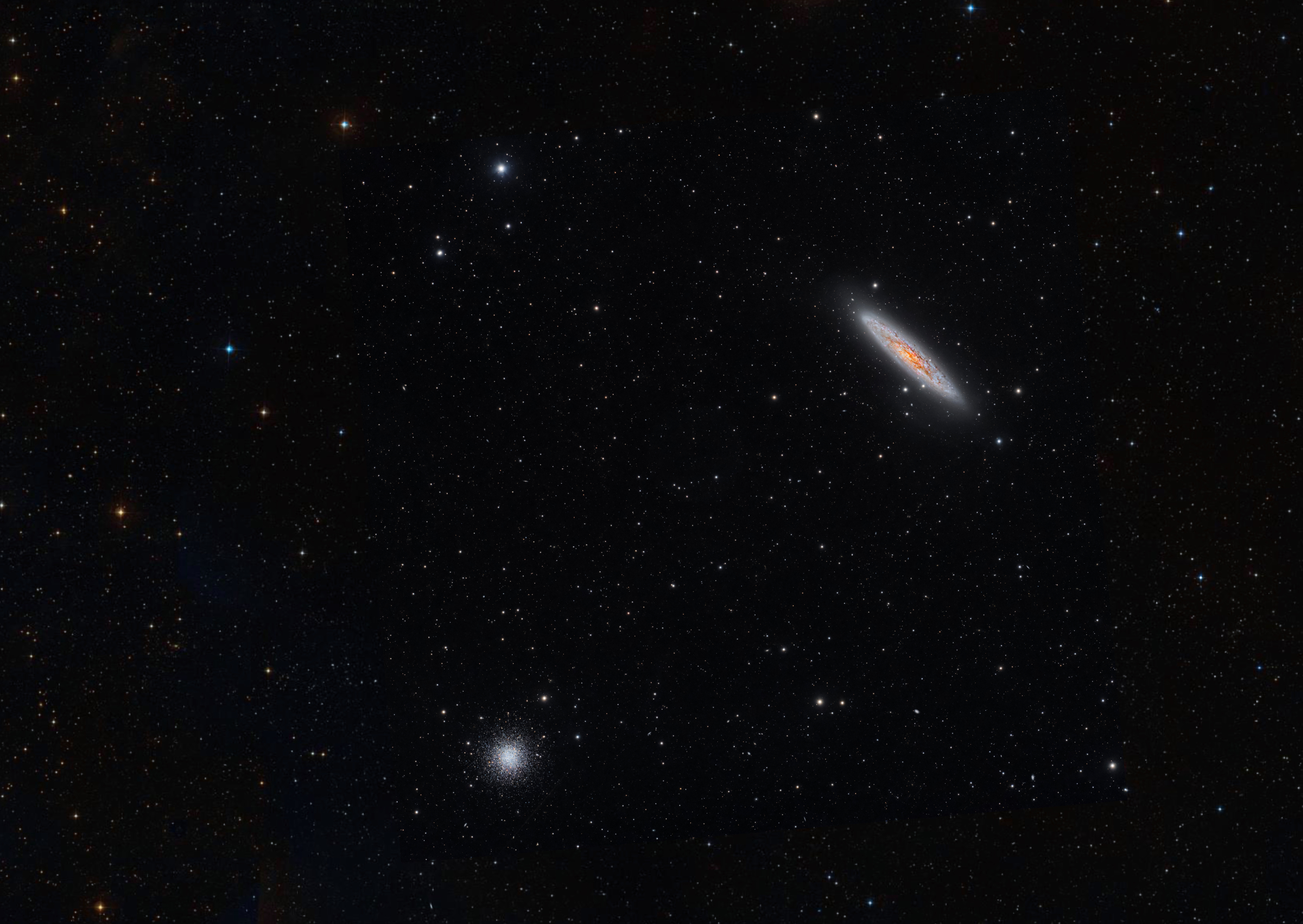
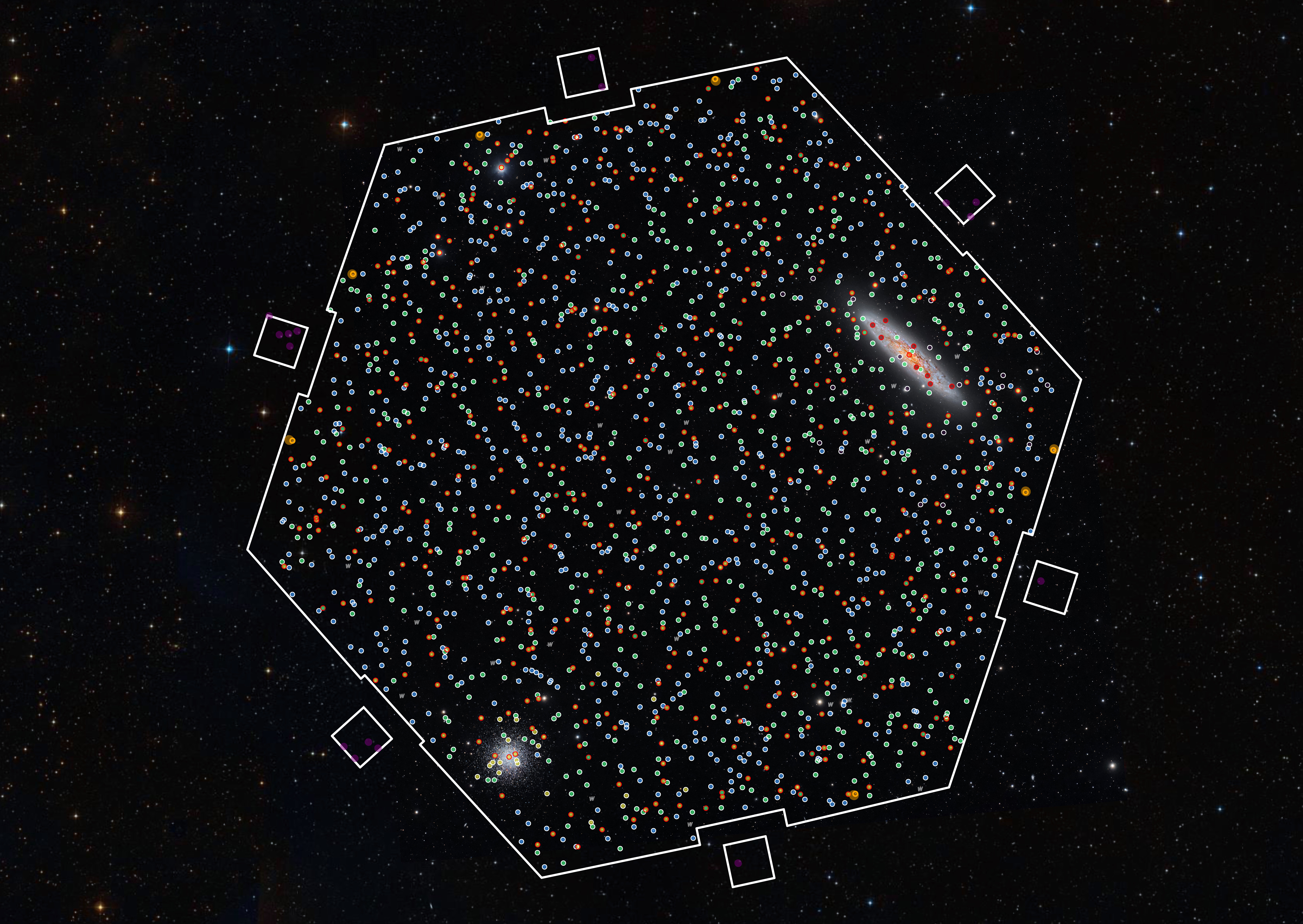
The First Light observations exemplify the unique capabilities of 4MOST: its ability to observe a very large field of view and its capability to investigate a large number of very different objects and science cases simultaneously in great detail.
One of the objects dominating the First Light observation of 4MOST is the elongated galaxy NGC253, also called the Sculptor or Silver Coin galaxy. Except for the Magellanic Clouds, it is the galaxy with the largest apparent diameter in the southern sky with nearly the same diameter as the moon, only much fainter. It was discovered by Caroline Herschel in 1783, is at a distance of about 11.5 million lightyears, and is known to currently form a lot of new stars. The 4MOST observations also capture a super star cluster, various hot and cold stars and their movements, and gas glowing from newly formed stars in this galaxy.
The other large object seen in the field is the Globular Cluster NGC288, a very dense group of about 100,000 very old stars in the outskirts of the Milky Way. It formed about 13.5 billion years ago in the very earliest phases of the formation of the Milky Way. Its stars contain very small amounts of most chemical elements heavier than hydrogen and helium, reflecting it’s pristine composition.
Next to these two very large objects, 4MOST obtained spectra of more than two thousand other objects in its first science observation. These include spectra of a large variety of bright and faint stars in our Milky Way, allowing scientists to determine their temperature, mass, diameter, velocity, age and evolutionary stage, and chemical composition. Beyond the Milky Way, spectra of a pair of overlapping galaxies at 900 million lightyears were obtained, as well as spectra of more than a thousand other galaxies near and far –up to 10 billion lightyears!– to determine their distance, internal velocity, and star formation history or the mass of their central black hole.
Users, Surveys, Science
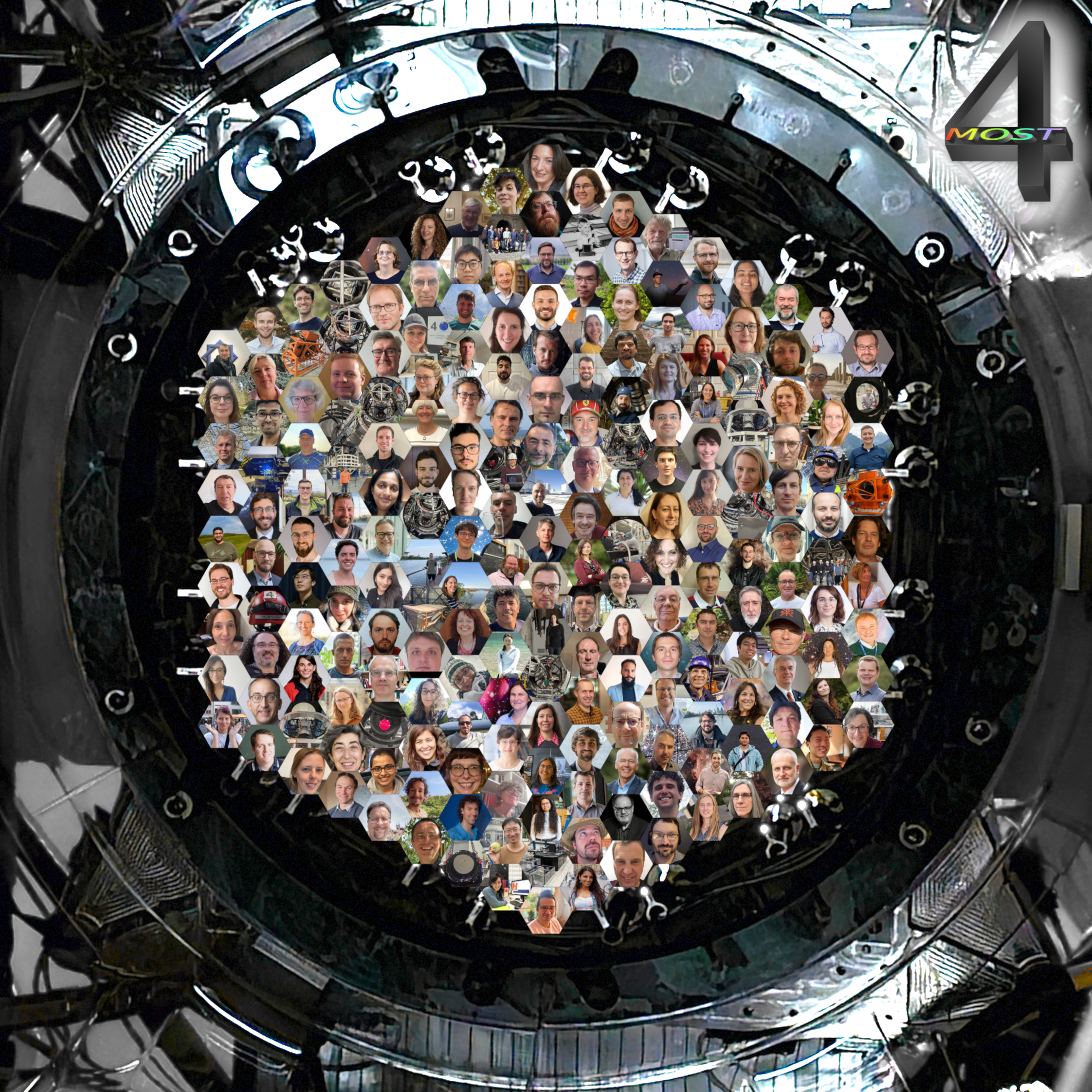
The 4MOST science team consists of more than 700 investigators from universities and research institutes around the world. In its first five years of operations, 4MOST will conduct 25 different science programmes, ten designed by institute members of the consortium that built the instrument, whereas the other fifteen programmes were selected by an external committee of astronomers. Uniquely, the multi-fibre nature of 4MOST enables many science programmes to be observed simultaneously. For example, a few fibres can be used to study rare objects, while at the same time another program can use most other fibres to make large statistical samples of stars or galaxies. Highlighted 4MOST science cases are the origin of the chemical elements and the formation of the first stars, the growth of the Milky Way over cosmic time, the formation and evolution of galaxies and black holes, the make-up of the unseen Dark Matter that seems to encompasses most of the mass in galaxies, and the nature of Dark Energy that drives the accelerating expansion of the Universe.
About the facility
At the heart of the system, 4MOST uses 2438 optical fibres, each the size of a human hair, to catch the light of celestial objects. Light from each of these fibres is transported to the spectrographs that break up the light in its different colours. A large, new, nearly 1m-diameter optical camera lens system was installed in the VISTA telescope of the European Southern Observatory (ESO) in Chile to give 4MOST a field of view on the sky of 2.5 degrees diameter, five times larger than the diameter of the moon and one of the largest in the world for a 4m-class telescope. 4MOST will observe a new set of objects in the sky every 10–20 minutes using a fibre positioner that moves all fibres to observe new objects in less than 2 minutes. The fibres transport the light to three spectrographs that each observe 800 objects simultaneously, where their light is first broken up in red, green, and blue components and then in further detail to then be registered by large 36 Megapixels detectors. There are two spectrographs that cover the entire colour spectrum from the very blue all the way into the infrared (370–950 nm), whereas a third spectrograph looks at higher wavelength resolution in three selected colour bands to better measure chemical element abundances in stars.
Operations
Planning of 4MOST observations is done remotely from the Max Planck Institute for Extraterrestrial Physics (MPE) in Garching near Munich. A few minutes before the next observation needs to start a next field and new objects are optimally selected based on the latest weather and observing conditions information. Executing the observations and maintaining the instrument is the responsibility of the European Southern Observatory (ESO). The data obtained are transferred to the 4MOST data centre at the University of Cambridge, where they are analysed with an extensive set of software pipelines to extract physical parameters of the studied objects. The analysis results are then transferred to data archives at the Leibniz Institute for Astrophysics Potsdam (AIP) and ESO to be distributed to all project members and to the entire scientific community for scientific exploration.



Consortium and Construction
The 4MOST facility is designed, built, and scientifically operated by a Consortium of 30 universities and research institutes in Europe and Australia under leadership of the Leibniz Institute for Astrophysics Potsdam (AIP). The main institutes involved in building and operating of the facility are:
- Leibniz Institute for Astrophysics Potsdam (AIP): consortium lead, telescope corrector and guiding system, metrology, control software, fibre system, and archive system
- Macquarie University / Australian Astronomical Optics (AAO): fibre positioner
- Centre de Recherche Astrophysique de Lyon (CRAL): low-resolution spectrographs
- European Southern Observatory (ESO): detector systems
- Max Planck Institute for Astronomy (MPIA): instrument control hardware
- Max Planck Institute for Extraterrestrial Physics (MPE): observation planning and remote operations
- Nederlandse Onderzoekschool Voor Astronomie (NOVA): calibration system
- University of Cambridge, Institute of Astronomy (IoA): data management
- University College London (UCL): Assembly and alignment of Wide Field Corrector
- Universität Hamburg (UHH), Hamburger Sternwarte: archive and user management
- Universität Heidelberg, Zentrum für Astronomie (ZAH): high-resolution spectrograph and instrument control software
All these institutes are also involved in the scientific analysis and exploration, as are the following major consortium partners: Durham University, Department of Physics, École polytechnique fédérale de Lausanne, Lunds universitet, Rijksuniversiteit Groningen, University of Bath, University of Western Australia, Uppsala unversitet, and minor consortium participants: Georg-August-Universität Göttingen, L'Observatoire de Paris, Laboratoire des Matériaux Avancés, Max-Planck-Institut für Radioastronomie, University College London, Universität Potsdam, University of Sussex, University of Tartu, University of Warwick, Lancaster University, University of Portsmouth, University of Southampton, and Queen’s University Belfast.